
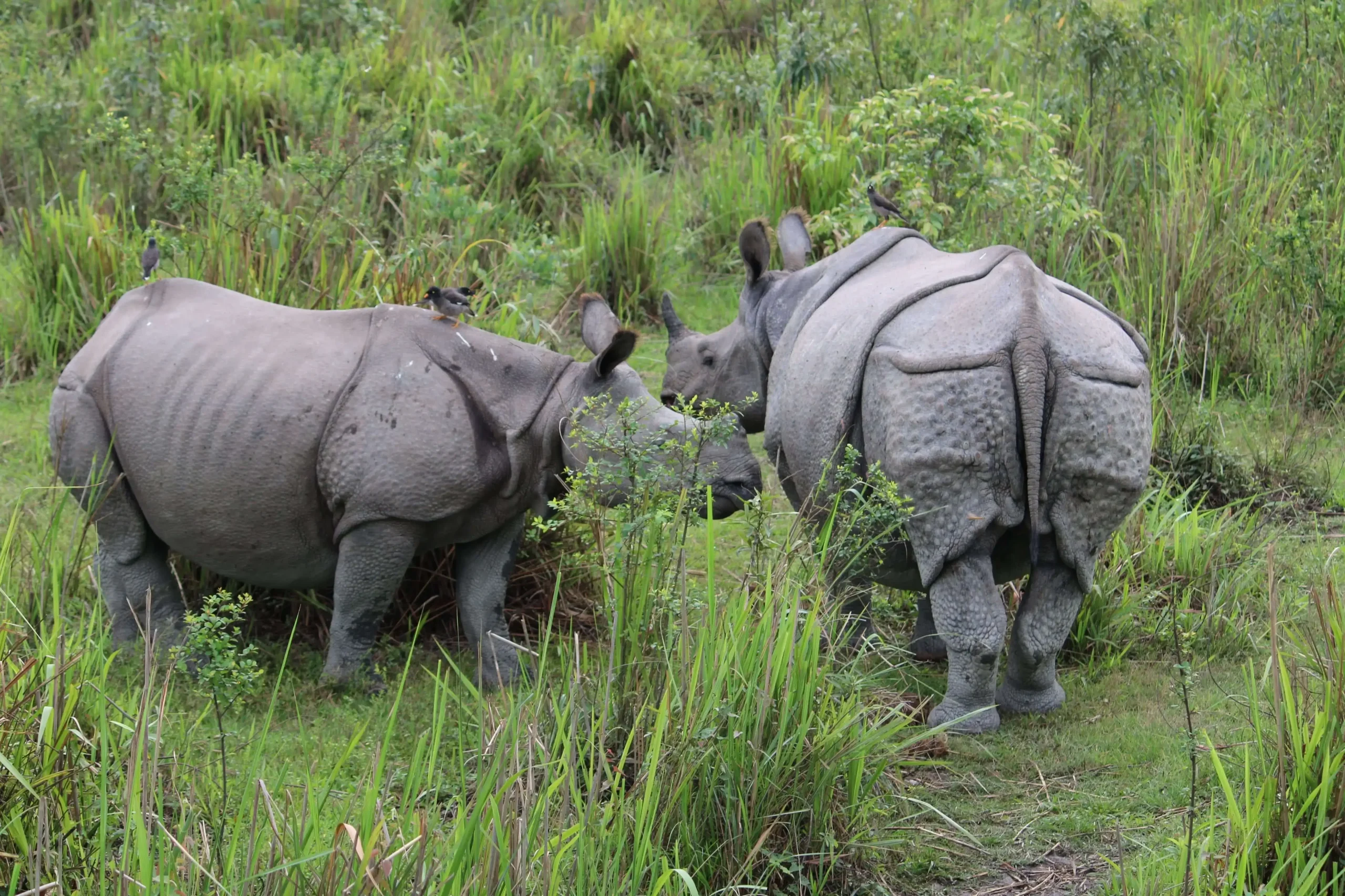
Nepal has roughly 752 one-horned rhinoceroses. More than nine in ten of them live in Chitwan National Park. This means that visiting Chitwan for a rhino sighting is less a matter of luck and more a matter of timing, and timing is something you can control.
The greater one-horned rhino is the largest rhino species in Asia, an animal that can weigh over 2,000 kilograms and move through dense jungle with an unsettling quietness. Standing a few metres from one on a jeep safari, watching it graze with the indifference of a creature that has no natural predators and knows it, is not something that photographs adequately capture. The scale of the animal and the stillness of the moment do not compress well into a frame.
Getting that moment depends largely on when you go. Here is the breakdown.
Why Timing Is Important
Chitwan spans 952 square kilometres of diverse habitat: dense sal forest, riverine forest, tall elephant grasslands, and wetlands along the Rapti and Narayani rivers. The rhinos are always in there. The question is whether the vegetation allows you to see them.
In the dry season, grass shortens, water sources concentrate, and animals move to predictable locations. The jungle becomes, if not transparent, at least navigable. In the monsoon, the grasslands grow to over two metres in height, the trails flood, and a rhino could be standing fifteen metres away without you knowing it.
Season does not determine whether you see rhinos. It determines how many you see, how close you get, and what kind of experience surrounds the sighting.
Season by Season Guide
October to November: Peak Season for Good Reason
The monsoon ends in late September, the trails dry out, and Chitwan enters what most visitors consider its main season. Temperatures sit comfortably between 15°C and 25°C during the day. The vegetation is still lush from the rains, which makes the landscape beautiful, but the grass has not yet grown to the heights that obscure wildlife. Rivers are accessible again. Canoe trips on the Rapti River resume in full.
Rhino sightings in October and November are consistently good. The animals are active in the cooler temperatures, moving across open areas near water and grassland edges. Multiple rhinos in a single jeep safari is a realistic expectation, not an optimistic one.
The catch: this is the busiest period in Chitwan. Lodges fill early, particularly for the more desirable rooms away from Sauraha town. Book accommodation and safari permits well in advance if you are visiting in October or November.
Wildlife conditions: Excellent.
Crowds: High.
Temperatures: Comfortable.
December to February: Quiet, Cold, and Underrated
Winter in the Terai is a different experience from winter anywhere with actual snowfall. Daytime temperatures are pleasant, typically 15°C to 22°C. Nights can drop toward 5°C or below, and morning mist sits in the grasslands in ways that are either atmospheric or frustrating, depending on how you feel about fog at 6 am.
The significant advantage of this season is that visitor numbers drop sharply after December. The lodges are quieter, the trails are less crowded, and the overall experience is more personal. Guides who are not moving between back-to-back groups have more time to explain what they are seeing.
January and February bring a specific and significant event: the annual grass harvesting. The Tharu community has traditional rights to harvest grass from Chitwan’s buffer zones during this period, and the harvest effectively strips away the tall grasslands that screen wildlife during the rest of the year. The result is that January and February offer the most open, unobstructed sightlines of any time in the calendar. A rhino that would otherwise be invisible at thirty metres is clearly visible at two hundred.
For photography, this is the finest window. The landscape is open, the light in the early mornings has a particular quality through the mist, and the animals are easier to locate and frame.
Wildlife conditions: Outstanding visibility, particularly in January and February.
Crowds: Low.
Temperatures: Cold mornings, comfortable afternoons.
March to May: The Hidden Peak Season
This is the window that most travellers overlook, and serious wildlife enthusiasts know about.
As the dry season advances through March and into April and May, water sources shrink. The rivers drop. The scattered ponds and oxbow lakes that dot the park landscape become increasingly important to the rhinos, elephants, and deer that depend on them. Animals concentrate around these points in predictable ways that make sighting almost guaranteed rather than merely likely.
March is widely considered the single strongest month for rhino encounters. The grass harvest has cleared the visibility. The heat is building, but has not yet reached the extreme temperatures of May. Tourist numbers are still relatively low after the winter trough. The combination of open sightlines, concentrated animals, and manageable crowds makes March an exceptional month for anyone whose primary goal is wildlife.
April and May deliver even higher sighting rates but at a cost: temperatures climb toward 35°C to 40°C and above, with May touching 42°C on the worst days. Safari drives at these temperatures are genuinely uncomfortable, particularly in the middle of the day. The wildlife compensates. Rhinos that are pushed to water by the heat become essentially reliable, and a morning drive in April along the Rapti River offers encounters that match anything the park produces at any other time of year.
The practical approach: book early morning (6 am to 9 am) and late afternoon (3 pm to 6 pm) safaris in March and April, and use the middle of the day for rest and shade. Do not try to push through a midday safari in May.
Wildlife conditions: Best of the year for rhino sightings.
Crowds: Low to moderate.
Temperatures: March comfortable, April warm, May extreme.
June to September: Monsoon Season
The park’s core zones partially close during peak monsoon, and those that remain open operate with significantly reduced safari routes. The tall elephant grass grows to its maximum height, the Rapti River swells, and jeep tracks in the lower areas become impassable.
Rhinos do not disappear during the monsoon. They are still there in the same numbers. But the combination of reduced access, restricted trails, and vegetation that completely screens wildlife from view makes this a poor season for anyone who came to see animals. Leeches are also abundant through the monsoon and into early October, which most visitors find unpleasant, even if they are technically harmless.
Some lodges offer discounted rates in the monsoon, and the landscape is genuinely verdant and beautiful in its own way. But if a rhino sighting is your goal, this is not the season to plan around it.
Wildlife conditions: Poor.
Crowds: Very low.
Temperatures: Hot and humid.
What to Know Before You Go
Jeep Safari vs. Walking Safari
The jeep safari is the most reliable option for rhino sightings. A 4WD vehicle can cover the core zones of the park, reach the oxbow lakes and deeper forest areas, and provide the elevation and stability needed for photography. Most visitors see multiple rhinos on a single morning drive.
Walking safaris operate with licensed guides and provide a fundamentally different experience: tracking footprints and fresh dung to locate animals on foot, moving quietly through the jungle at ground level. The encounter with a rhino at walking distance is genuinely visceral. Walking safaris require guides who know the park intimately and should only be done with properly trained and experienced staff. Ask your operator specifically about guide credentials.
Canoe trips on the Rapti River are excellent for birdwatching and for observing rhinos and crocodiles along the riverbank. They are not the primary safari modality for deep-park wildlife, but offer a pace and perspective that jeep safaris cannot replicate.
When is the Day to Go
Early morning and late afternoon are the two windows when rhinos are most active, and light conditions are best. Safaris typically depart at first light (around 6 am) and again in the mid-afternoon (around 3 pm). The midday period, particularly in the hotter months, sees reduced animal movement and harsh photographic light.
If you can only do one safari, make it the early morning.
What to Wear
Neutral colours: khaki, olive green, stone, grey. Rhinos have poor eyesight but react to movement and contrasting colour. Avoid white, bright red, or vivid patterns. A light layer for early morning drives is useful in all seasons except the heat of late April and May. In the cooler months, a proper fleece is worth having in the jeep.
The Tharu Grass Harvest
Between late January and mid-February, the Tharu community harvests grass from Chitwan’s buffer zones, a traditional right that predates the national park. The harvest strips away the tall screening vegetation and opens the landscape in ways that no other period of the year matches. If photography is your priority, plan your visit to coincide with this window.
A Note on Chitwan's Conservation Story
Nepal’s rhino population was under 100 animals in the 1960s, reduced by poaching and habitat loss to near collapse. Chitwan National Park was established in 1973, in part to protect what remained. Decades of anti-poaching work, community engagement, and conservation infrastructure have brought the population to over 700 animals in Chitwan alone, with Nepal’s total approaching 752 as of the most recent census data.
This is one of the great conservation success stories in Asia. Visiting Chitwan and paying national park entry fees directly supports the infrastructure that made that recovery possible. The rhinos you are watching exist in part because of decisions made fifty years ago to protect this landscape, and in part because local Tharu communities became partners in conservation rather than being excluded from it.
That context does not change the sighting. But it makes the sighting mean something different.
FAQs
1. What is the single best month to see rhinos in Chitwan National Park?
March is consistently the strongest month for rhino sightings. The dry season has been progressing long enough that water sources have concentrated animals predictably, the Tharu grass harvest has cleared visibility through February, the heat is building but has not yet reached extreme levels, and tourist numbers are relatively low.
2. Is it possible to see rhinos during the monsoon season in Chitwan?
Technically, yes, but practically, it is a poor time to plan a rhino-focused trip. The core zones of the park partially close, jeep safari routes are significantly restricted, and the tall elephant grass grows to heights of two metres or more, effectively screening wildlife from view.
3. How many rhinos are realistically seen on a single safari in Chitwan?
In the peak dry season months of February through April, seeing three to six rhinos on a single morning jeep safari is entirely realistic. Multiple sightings, including rhino mothers with calves, are common at the oxbow lakes and along the Rapti riverbanks. In October and November, two to four rhinos per safari is the typical range. In December and January, the number is similar, but sightlines improve progressively as the grass harvest approaches. Even in the quieter winter months, seeing no rhinos on a proper jeep safari into the core zones would be unusual.
4. Is a walking safari safe for seeing rhinos in Chitwan?
Walking safaris in Chitwan carry a genuine risk that jeep safaris do not. The park has a high density of rhinos, sloth bears, and other large animals in dense vegetation. Encounters at close range on foot are possible and require experienced, trained guides who know the terrain and animal behaviour in detail. If you choose to do a walking safari, verify that your guides are properly licensed and that the operator has a clear safety protocol. The experience of tracking and encountering a rhino on foot is unlike anything a vehicle provides, but it should be chosen with clear eyes about what it involves.
5. Do I need to book safari permits in advance?
For the peak season months of October, November, and the March to April window, booking permits and accommodation in advance is strongly recommended. Chitwan’s daily visitor quota for the core zones is finite, and the best departure slots (early morning) fill quickly through reputable operators. For the quieter months of December through February, advance booking is still advisable for quality accommodation, but permits are generally more available. Adventure World Travel handles all permit arrangements as part of the Chitwan package, so you are not navigating this independently on arrival.