There are journeys in Nepal that follow well-worn tourist trails, and there are journeys that go somewhere most people never reach. The road from Kathmandu to Lo Manthang is the latter.
Fourteen days that cover ancient Hindu temples, the world’s deepest river gorge, high Himalayan pilgrimage sites, Tibetan Buddhist monasteries, cave dwellings thousands of years old, and the medieval walled capital of a kingdom that existed largely in isolation until the 1990s.
No two days look the same, and by the time the hot springs at Tatopani come into view on the returning day, the distance from Kathmandu’s airport arrival feels like a different world entirely.
Upper Mustang Road Trip Attractions
- A 14-day Upper Mustang road trip from Kathmandu to Lo Manthang through Pokhara, Jomsom, and Muktinath.
- Explore ancient monasteries, Tibetan villages, Chhoser caves, and the walled city of Lo Manthang.
- Travel through the Kali Gandaki Gorge, Himalayan desert landscapes, and high-altitude valleys.
- Best time to visit: March–May and September–November for clear skies and ideal weather.
- Requires Upper Mustang restricted permit, ACAP, TIMS, and a licensed guide.
- Ideal for travelers seeking a jeep-based Himalayan adventure without long trekking.
Adventure World Travel’s Upper Mustang road trip covers this full arc by jeep and private vehicle, with two nights in Kathmandu, two in Pokhara, and the remaining days moving progressively deeper into one of Nepal’s most extraordinary landscapes before returning through the Kali Gandaki valley to Pokhara and Kathmandu.
Here is the full journey.
Phase One: The Valley Cities
The trip opens in Kathmandu, and the capital earns its time on the itinerary. The heritage circuit covers Swayambhunath, Pashupatinath, Boudhanath, and the three Durbar Squares at Kathmandu, Patan, and Bhaktapur. Each site carries a density of history, religious practice, and architectural detail that rewards unrushed attention.
Pilgrims bathe at Pashupatinath. The carved wooden exterior of Bhaktapur Durbar Square, widely considered the finest of the three valley squares, document centuries of Newar craftsmanship in a form that has survived where comparable work elsewhere has not.
The route to Pokhara breaks for Manakamana Temple, the wish-fulfilling goddess shrine reached by cable car above the Trishuli river gorge, before the Prithvi Highway delivers the journey to the lakeside city. Pokhara operates at a different pace from Kathmandu. The Annapurna range sits on the northern horizon.
Phewa Lake reflects the sky. Sarangkot at dawn provides the panoramic Himalayan view that Pokhara is built around, and the remaining sightseeing, Devi’s Fall, the World Peace Pagoda, and the island temple at Tal Barahi, fills the balance of the day without pressure.
Phase Two: The Kali Gandaki Corridor
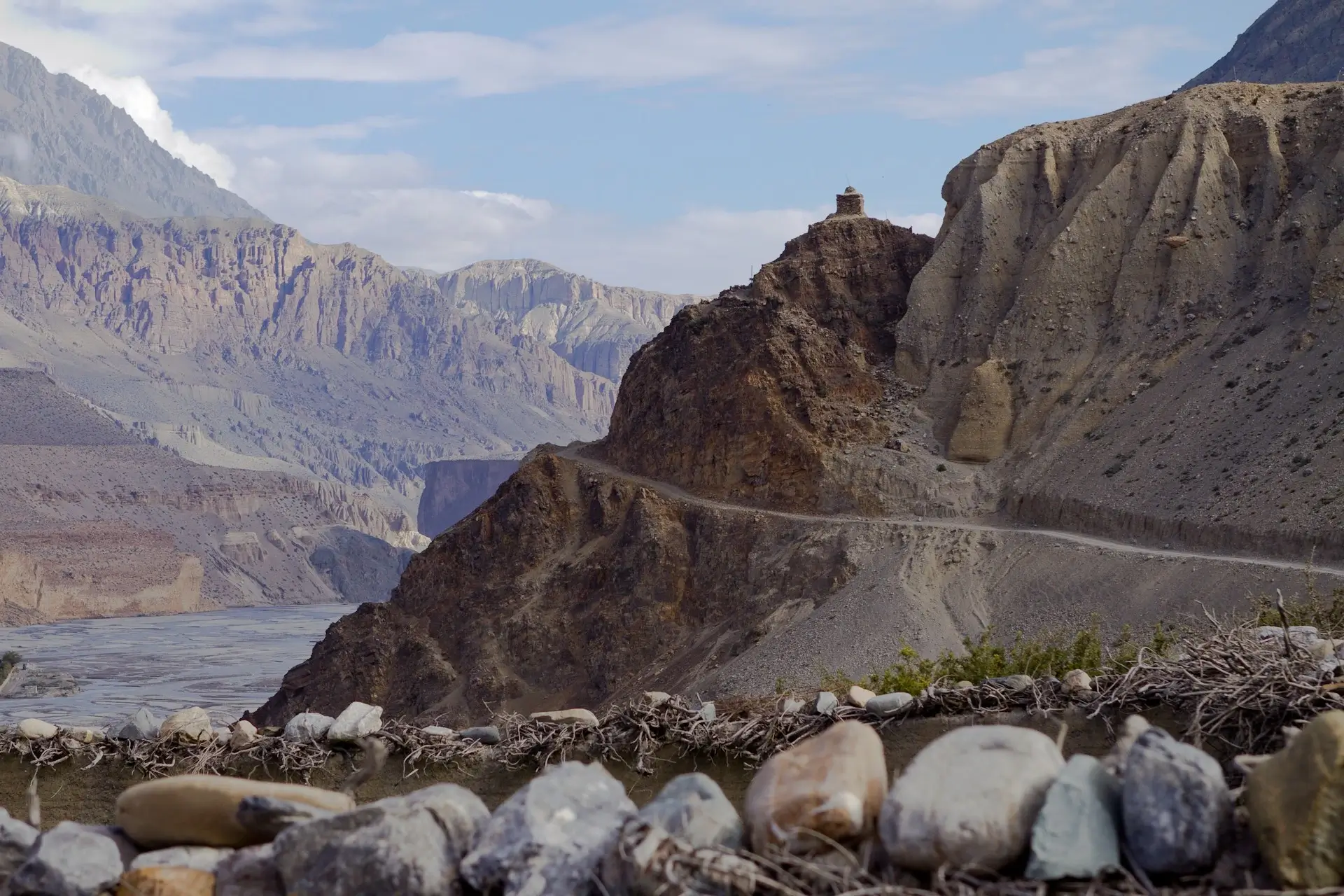
The jeep route north into Mustang follows the Kali Gandaki river, one of the oldest trade corridors in the Himalayan region and the gorge that runs between Annapurna and Dhaulagiri, the two highest peaks bordering one of the deepest river valleys on earth. The landscape transformation along this corridor is gradual and then sudden. Subtropical forest gives way to terraced fields, then to open scrubland, then to the high-altitude desert that begins above Jomsom and defines everything north of it.
The stops along this corridor carry weight. Tukuche preserves the trade architecture of the Thakali people, who controlled the salt-for-grain route between Tibet and the Terai lowlands for generations. Marpha, Nepal’s apple capital, sits at 2,670 metres with whitewashed lanes and orchards that have supplied the region’s fruit brandy trade for decades. Jomsom is the administrative hub of Mustang district and the point where flights, roads, and trekking routes converge.
How Far Is Jomsom to Muktinath by Road?
The road distance from Jomsom to Muktinath is approximately 21 to 23 kilometres (13 to 14 miles), with most routes passing through the medieval village of Kagbeni. While that may sound like a short stretch on paper, the journey involves a significant altitude gain — from Jomsom at 2,720m up to Muktinath at 3,760m — so the terrain, road quality, and your choice of transport all play a major role in how long it actually takes.
Muktinath at 3,800 metres is the pilgrimage centrepiece of the corridor. The 108 ice-cold water spouts, the eternal flame of Jwala Mai Temple burning from a natural underground gas source, and the convergence of Hindu and Buddhist traditions at a single site make it one of the most layered religious destinations in South Asia. The accommodation here sits at an altitude, the air is cold and thin, and the change from the valley below is immediate.
Phase Three: Upper Mustang and the Lo Kingdom
North of Muktinath, the road enters the Upper Mustang restricted area, and the landscape crosses into something categorically different. The terrain is the high Tibetan plateau: eroded sandstone formations, wind-carved canyons, whitewashed village clusters emerging from ochre and grey earth, and a sky that sits larger and lower than anywhere in the lower valleys. The cultural register shifts entirely. This is Tibetan Buddhist territory, physically and historically connected to the plateau north of the Himalaya rather than to the Nepal below.
The route north passes through Ghami, notable for one of the longest mani walls in Nepal and the carved architecture of its ancient buildings, and Tsarang, whose fortress palace and monastery document the history of the Lo Kingdom before its capital. Both are stops worth time rather than a drive-through.
Lo Manthang is the destination that justifies the journey north. The walled medieval city, enclosing a royal palace, active monasteries, and a street grid that has not changed substantially in six centuries, delivers on the reputation that precedes it. Thubchen and Jampa Monasteries hold 15th-century murals, partially restored by the American Himalayan Foundation, that represent some of the finest surviving Tibetan Buddhist art in the region. The King’s Palace documents the royal lineage of a kingdom that maintained independence through centuries of regional disruption.
A full day dedicated to Lo Manthang and the Chhoser cave dwellings nearby earns its place in the schedule. The cliff-face caves, multi-storey structures carved directly into rock and used historically for meditation, burial, and habitation, provide an archaeological layer to the visit that the city itself, remarkable as it is, does not supply alone.
The Return
The descent south retraces the Kali Gandaki corridor at a different pace than the ascent. Tatopani, the hot spring village at 1,190 metres whose name translates simply as hot water, provides the physical conclusion that ten days at altitude earns. The geothermal pools and dinner from locally grown organic produce mark the transition back to a lower elevation before the drive to Pokhara, the short domestic flight to Kathmandu, and a final evening in Thamel before departure.
The contrast of the last evening is not incidental. The narrow lanes and sensory density of Thamel against the memory of Lo Manthang’s plateau silence capture the range of what this journey covers. Fourteen days, three distinct landscapes, and a cultural and historical depth that few itineraries of this length can match.
Permits Required for Ultimate Upper Mustang Road Trip
Upper Mustang is a restricted area. The permit costs USD 500 per person for ten days, with USD 50 per additional day, and must be obtained through a registered agency. A licensed guide is mandatory. Standard TIMS and Annapurna Conservation Area permits are required in addition. Adventure World Travel handles the full permit stack as part of the booking process.
Conclusion
Nepal is one of those countries where the distance between what you expect and what you actually find tends to be large. The Upper Mustang road trip covers more of that distance than almost any other itinerary available in the country.
Adventure World Travel designs this journey to be experienced fully, with the logistics, permits, and professional guidance handled so that the journey itself is what you focus on. Contact the team to begin planning your Upper Mustang road trip.
FAQs on Upper Mustang Road Trip
1. What is the best time of year for the Upper Mustang road trip?
Spring, from March to May, and autumn, from September to November, are the primary seasons. April is particularly strong for the combination of comfortable temperatures, rhododendron bloom on the lower Mustang approaches, and the possibility of timing the visit to the Tiji Festival at Lo Manthang in late April or May.
2. Is the Upper Mustang road trip suitable for people who do not trek?
Yes. The itinerary is primarily jeep and vehicle-based. Walking is involved at specific sites, including Muktinath, Lo Manthang, the Chhoser caves, and village explorations, but these are short-duration walks at the site level rather than multi-day trekking. Reasonable mobility and comfort with travel at altitude are the primary requirements rather than trekking fitness.
3. How difficult is driving through Upper Mustang?
The road from Jomsom northward through Upper Mustang is an unpaved mountain road that requires experienced drivers and appropriate vehicles. Adventure World Travel uses jeeps and private vehicles suited to the terrain with drivers experienced on the route.
4. What altitude does the itinerary reach, and how is acclimatisation managed?
The highest point on the itinerary is Muktinath at 3,800 metres, with Lo Manthang at 3,840 metres. The itinerary’s gradual ascent over several days from Kathmandu through Pokhara and Thasang before reaching Muktinath provides natural acclimatisation. Adequate hydration, awareness of early altitude sickness symptoms, and communicating any discomfort to the guide are the practical management steps. The guide is experienced in identifying altitude-related issues and advising on the appropriate response.
Lorem ipsum dolor sit amet, consectetur adipiscing elit. Ut elit tellus, luctus nec ullamcorper mattis, pulvinar dapibus leo.
5. How long in advance should I book the Upper Mustang road trip?
At least two to three months in advance for spring and autumn peak season departures. The Upper Mustang restricted area permit requires advance processing, and the permit is issued in limited numbers, making early booking essential for preferred departure dates. Adventure World Travel manages the full permit application and logistics as part of the booking process.