
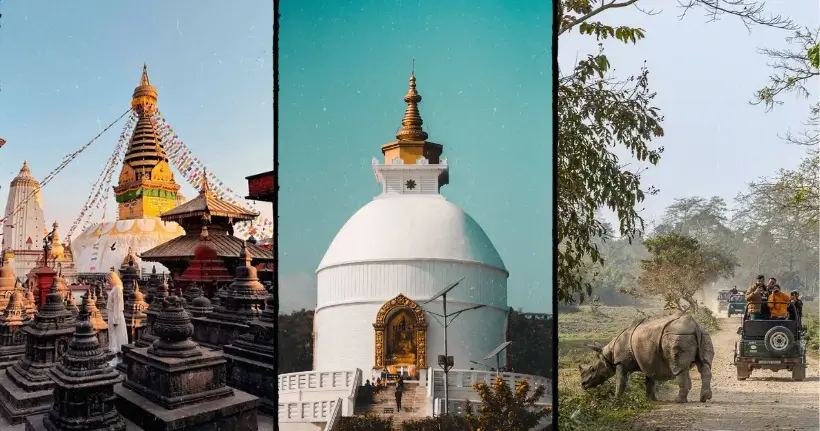
When you arrive in Nepal with a carry-on bag, a downloaded Nepali language video used for approximately four minutes on the flight, and the kind of optimism that evaporates quickly at high altitude, you’ll be intrigued. Eight days later you will leave with a full checked bag of things you will buy in Thamel, a moderate rhinoceros obsession, and a genuine hesitation to get on the plane home.
Kathmandu Pokhara Chitwan Tour: Summary
- An 8-day Nepal tour covering Kathmandu, Chitwan National Park, and Pokhara.
- Explore heritage sites, Durbar Squares, Swayambhunath, and Thamel in Kathmandu.
- Experience jeep safaris, canoe rides, rhino spotting, and Tharu culture in Chitwan.
- Enjoy Phewa Lake, Sarangkot sunrise, caves, and Himalayan views in Pokhara.
- Best for travelers wanting a balanced Nepal trip with culture, wildlife, and scenic landscapes.
- Ideal as a first-time Nepal itinerary without trekking.
Kathmandu: Louder Than You Expect
Kathmandu gets undersold and overwhelming in equal measure. The city assaults the senses in ways that no amount of reading prepares you for, and then, somewhere between Swayambhunath and the third Durbar Square, you start to understand that the density is the point.
Swayambhunath, the Monkey Temple, earns its nickname immediately. The monkeys are everywhere, completely unbothered by tourists, and operating with the confidence of individuals who know this is technically their hill. The stupa at the top, draped in prayer flags with the painted eyes of the Buddha looking out across the valley in four directions, is one of those places that photographs well and still somehow exceeds the photograph in person.
Kathmandu Durbar Square and Patan Durbar Square follow, and by the third carved wooden facade you begin to understand that Newar craftsmanship is not a heritage category so much as a way of building that treats every surface as an opportunity. The detail in the woodwork, windows, doors, and roof struts carved with figures and patterns that have survived centuries of weather and earthquakes, is the kind of thing that stops you mid-stride repeatedly.
The honest caveat about Kathmandu is that two days of heritage sightseeing is productive but leaves things unfinished. There is enough here for a week. The tour covers the essential circuit efficiently without rushing, which is the right call.
Chitwan: The Wildlife Portion
Chitwan National Park is a UNESCO World Heritage Site that does not behave like one. It is a functioning ecosystem with real animals in it, which sounds obvious until you have spent time at wildlife destinations where the wildlife portion is largely theoretical.
The canoe ride down the Rapti River is the low-key highlight that nobody tells you about. Sitting in a wooden boat that moves with minimal noise through a river system lined with trees, watching a gharial crocodile do absolutely nothing on a sandbank twenty metres away, produces a specific quality of calm that is difficult to locate in daily life. The expert oarsmen navigate without commentary unless you want it, which is the correct approach.
The jeep safari on day four covers the park’s interior in vehicles with elevated seating that gives clear sightlines across the grassland and into the tree line. The one-horned rhinoceros is not subtle. It is a large, prehistoric-looking animal that appears from the tall grass with the air of something that has never needed to worry about anything, which is accurate. Seeing several in their actual habitat rather than behind glass recalibrates your sense of what wildlife observation is supposed to feel like.
The Bengal tiger is the animal everyone wants to see and not everyone does. The park has them. The sighting is not guaranteed, which is what makes it a genuine wildlife experience rather than a zoo visit. The consolation prize for not seeing a tiger is seeing essentially everything else: sloth bears, monitor lizards, hundreds of bird species, and the particular satisfaction of the jungle after rain.
The Tharu cultural performance on the first evening is worth attending. The Tharu people are indigenous to the Terai lowlands and their dance and music tradition is specific to this region. It is not a tourist recreation of something that no longer exists. These are living cultural practices from a community that has inhabited this landscape for generations.
The Drive Between Destinations: Kathmandu–Chitwan
This tour involves significant road time. Kathmandu to Chitwan is roughly 180 kilometres and five to six hours. Chitwan to Pokhara is 160 kilometres and another five to six hours. Pokhara back to Kathmandu is 210 kilometres and seven to eight hours.
If you approach these drives as dead time between destinations you will find them frustrating. If you approach them as the connective tissue of a landscape that transitions from Himalayan foothills to subtropical plains to lakeside hills, they are a different experience.
The Prithvi Highway between Kathmandu and Pokhara follows river gorges through terrain that produces the kind of scenery most countries would make a national park. Nepal uses it as a main road.
The private transport provided is comfortable. You are not on a public bus. This matters considerably across these distances.
Pokhara: The Part of the Trip You Do Not Want to End
Pokhara has a reputation for being the most relaxed city in Nepal, and it earns this the way places that are genuinely relaxed do: without trying. The city sits at the edge of Phewa Lake with the Annapurna range on the northern horizon, and the combination of water, mountains, and a lakeside atmosphere that does not take itself seriously produces somewhere that people arrive for two days and leave four days later.
The Sarangkot sunrise is the mandatory early alarm that justifies itself. The drive up the hill in the dark, the gathering of other people with the same idea and the same level of alertness, and then the Annapurna range emerging from the pre-dawn darkness as the light builds from east to west is one of those experiences that earns its reputation by actually delivering on it. The Phewa Lake in the foreground and the snow peaks filling the northern sky are not subtle.
Devi’s Fall is a waterfall that disappears into an underground tunnel, which is geologically interesting and practically photogenic. The adjacent Gupteshwor Cave dedicated to Lord Shiva and its natural rock formations extend the visit without feeling padded. The World Peace Pagoda requires climbing a flight of stairs and rewards the effort with views across the full Pokhara valley that the lakeside does not provide.
The evening boat ride on Phewa Lake to Tal Barahi Temple, the island pagoda accessible only by water, is exactly the pace that Pokhara is built for. The light on the lake in the late afternoon, the two-storey pagoda materialising from the water as you approach, and the return across the flat surface as the mountains darken to silhouette is the kind of ending to a day that makes subsequent random day afternoons feel like a reasonable trade-off.
Thamel in Kathmandu on the final evening provides the decompression that the circuit needs. After jungle drives and altitude sunrises and lakeside temples, the narrow lanes packed with shops, restaurants, and the accumulated souvenirs of everyone else’s Nepal trips are simultaneously chaotic and oddly comforting. You will buy things you did not intend to buy. This is simply what happens in Thamel and there is no point resisting it.
What the Kathmandu Pokhara Chitwan Tour Includes
The practical structure is worth knowing before booking. The tour runs eight days with accommodation provided throughout, MAP (Modified American Plan) basis meaning breakfast and dinner are included at all hotels, and private transport between all destinations. An experienced English-speaking guide and porter for luggage are included across the full itinerary. Airport transfers are handled from arrival to departure.
What is not included: personal travel insurance, Nepal visa fees, cultural site entrance fees, and personal beverages. The visa is obtained on arrival at Tribhuvan International Airport and is straightforward. The entrance fees across Chitwan, the Durbar Squares, and other heritage sites add up to a meaningful figure over eight days, so factor that in when assessing the overall cost.
Final Judgment on Kathmandu Pokhara Chitwan Tour in Nepal
Eight days covering Kathmandu’s heritage circuit, two days of genuine wildlife in Chitwan, and Pokhara’s lake and mountain combination is a well-constructed introduction to Nepal’s range. It does not attempt to include everything, which is the correct editorial decision. It covers the three most distinct environments the country offers at an accessible level, with enough time at each to move past surface-level tourism into something closer to actual experience.
The rhinoceros alone is worth the flight.
FAQs on Kathmandu Pokhara and Chitwan Tour in Nepal
1. Is eight days enough time for the Kathmandu, Chitwan, and Pokhara circuit?
Eight days covers the essential experience of all three destinations without serious compression. Kathmandu gets two full sightseeing days, Chitwan gets two days of wildlife activities, and Pokhara gets a full day plus the Sarangkot sunrise morning. If you have additional time, Pokhara is the most rewarding destination. The lakeside pace and the proximity to Himalayan viewpoints and short treks makes extra days there more productive than adding days in Kathmandu.
2. What is the best time of year to do this tour?
October through November is the peak season for good reason: post-monsoon clarity produces the sharpest mountain views at Sarangkot and Nagarkot, wildlife activity in Chitwan is high, and temperatures across all three destinations are comfortable. February through April is the second window with similar advantages. The monsoon months from June through September bring lush green landscapes but cloud cover that reduces mountain views significantly and makes the Chitwan jungle hot and humid.
3. How demanding are the wildlife activities at Chitwan?
The canoe ride and jeep safari are accessible for most fitness levels and ages. The canoe ride is conducted on flat river water with life jackets and experienced oarsmen. The jeep safari uses elevated vehicles with theatre-style seating that does not require physical exertion beyond managing the movement of the vehicle on jungle tracks. Bird watching and village visits are walking activities at a relaxed pace. No significant physical preparation is required.
4. What should I pack for the Sarangkot sunrise in Pokhara?
Warm layers are the practical requirement. Even in October, the pre-dawn temperature at Sarangkot is cold enough to make a jacket and fleece necessary. Comfortable shoes for the short walk to the viewpoint, a camera with a capable low-light setting, and the willingness to be awake significantly before sunrise covers the preparation. The drive from Pokhara lakeside to Sarangkot takes around 30 to 40 minutes and departs early enough that a 4:30 am wake-up is realistic.
5. How do I book the Kathmandu, Pokhara, and Chitwan tour with Adventure World Travel?
Contact Adventure World Travel directly through adventureworldtravels.com to discuss departure dates, group sizes, and any itinerary customisation. The tour runs as a private arrangement rather than a fixed group departure, which means the schedule and pace can be adjusted to fit your specific travel dates and preferences.