
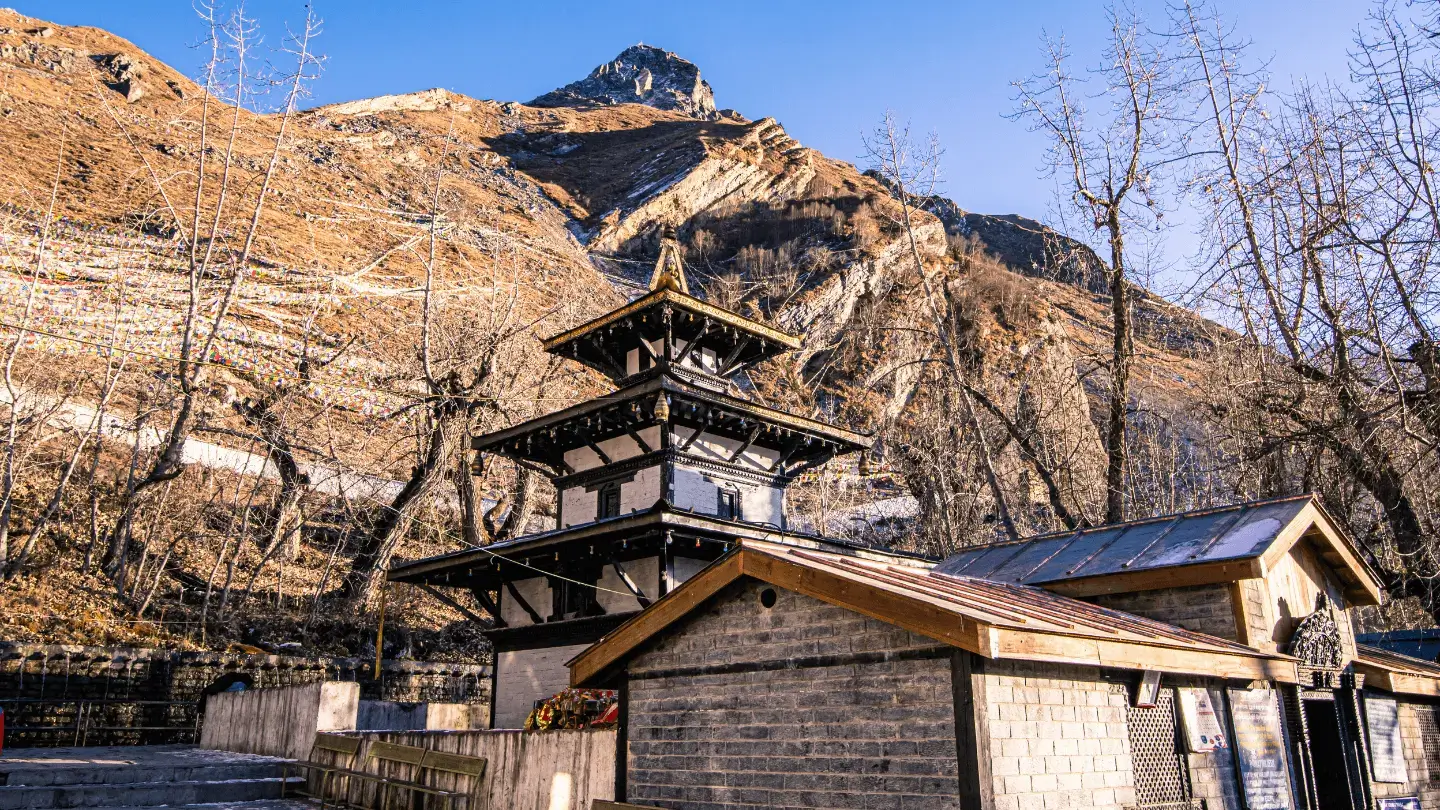
At 3,800 metres in the Mustang district of Nepal, Muktinath Temple sits at an altitude where the air is thin, the landscape is austere, and the wind moves through the valley with a consistency that makes every element of the environment feel deliberate. Pilgrims arrive here having travelled from across Nepal, India, and the broader Himalayan world.
Some have walked for days. Some have come by jeep along a road that did not exist two decades ago. All of them arrive at a site that both Hindu and Buddhist traditions have considered sacred for centuries, for reasons that are distinct within each tradition and yet converge on the same place.
That convergence is what makes Muktinath unusual. Shared sacred sites in South Asia are not unheard of, but a site of this significance to two distinct traditions, not as a point of compromise but as a place each tradition holds in its own right for its own reasons, is rare enough to warrant understanding properly.
The Site Itself
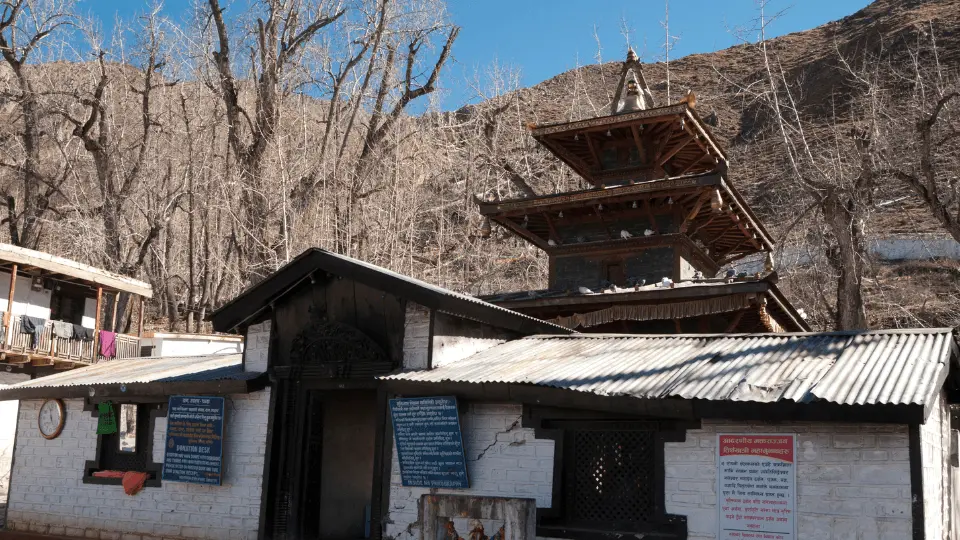
The Muktinath complex sits on a slope of the Thorong La massif, approached through Ranipauwa village. The complex includes several distinct structures and features spread across a large compound.
The main elements of the Muktinath complex:
- The Vishnu shrine housing the main deity, a golden image of Vishnu in his form as Mukti Narayan
- 108 water spouts arranged in a semicircle, each carved in the shape of a cow’s head, through which spring water flows year-round
- Two small Buddhist temples, Jwala Mai and Sama Gompa, within the compound
- The Jwala Mai shrine housing the eternal flame, a natural gas seepage that has burned continuously from an underground source for centuries, alongside water and earth
- Prayer wheels lining the paths through the compound
- The walled garden approach planted with poplars that mark the transition from the open valley to the sacred enclosure
The physical setting amplifies the religious significance. The barren high-altitude landscape surrounding the complex, arid and windswept, makes the flowing water from the 108 spouts and the underground flame feel like genuine anomalies rather than constructed features.
Why Hindus Consider Muktinath Sacred
The Divya Desam Connection
For Vaishnavite Hindus, Muktinath is one of the 108 Divya Desams, the sacred temples of Vishnu sung by the Alvars, the Tamil poet-saints whose verses form the Nalayira Divya Prabandham. Being counted among the 108 Divya Desams places Muktinath in the company of the most significant Vaishnava pilgrimage sites in the world, most of which are located in South India. Muktinath is the only Divya Desam in the Himalayan region and the northernmost of all 108.
The name Muktinath translates as Lord of Salvation, mukti meaning liberation or salvation and nath meaning lord. The site is associated with the attainment of moksha, liberation from the cycle of birth and death, which is the ultimate goal of Hindu religious practice. Pilgrims who complete the ritual circuit at Muktinath are believed to be freed from the cycle of rebirth.
The Ritual at the 108 Spouts
The purification ritual at Muktinath involves bathing under each of the 108 water spouts in sequence. The water is glacier-fed and extremely cold at 3,800 metres regardless of season. The number 108 carries deep significance in Hindu cosmology, appearing across rosary beads, sacred texts, and ritual practice throughout the tradition.
The act of bathing under all 108 spouts is a physical and spiritual undertaking simultaneously. Pilgrims who complete it are believed to have cleansed themselves of accumulated karma. The cold is not incidental to the practice. It is part of it.
The Shaligram Connection
The Kali Gandaki river flowing through the valley below Muktinath carries Shaligram stones, black ammonite fossils that erode from the riverbed and are considered sacred manifestations of Vishnu in Hindu tradition. These fossils are found in unusual concentration along this specific section of the Kali Gandaki due to the geological history of the region, which was once a Tethys sea floor. Their presence in the river below the Muktinath complex is understood as further confirmation of the site’s divine significance.
Shaligram stones are used in Hindu worship across Nepal and India. Pilgrims collect them from the Kali Gandaki as part of the Muktinath pilgrimage. The stones are considered self-manifested images of Vishnu, requiring no consecration to be used in ritual.
Why Buddhists Consider Muktinath Sacred
Chumig Gyatsa: The Hundred Waters
In Tibetan Buddhism, Muktinath is known as Chumig Gyatsa, which translates as Hundred Waters, a reference to the 108 spouts which Tibetan Buddhist tradition counts at one hundred. The site is considered one of the 24 Tantric places in the Himalayan region, locations associated with the transmission and practice of Vajrayana Buddhism.
The site’s sacred status in Buddhist tradition predates the Hindu temple complex and is associated with the travels of Guru Rinpoche, also known as Padmasambhava, the 8th century master who brought Vajrayana Buddhism from India to Tibet. Guru Rinpoche is said to have meditated at Muktinath during his journey north, and the site is considered one of the places where his spiritual power is particularly accessible.
The Flame, Water, and Earth
The convergence of fire, water, and earth at Muktinath holds specific significance in Buddhist cosmological understanding. The eternal flame burning from an underground gas source alongside flowing water and the earth of the valley floor represents a meeting of elements that Buddhist tradition associates with the power of the place as a site for tantric practice and meditation.
The two Buddhist temples within the compound, Jwala Mai and Sama Gompa, are active religious institutions with resident monks and regular ritual practice. They are not heritage structures maintained for visitors. They function as living monasteries within the larger pilgrimage complex.
The Broader Mustang Context
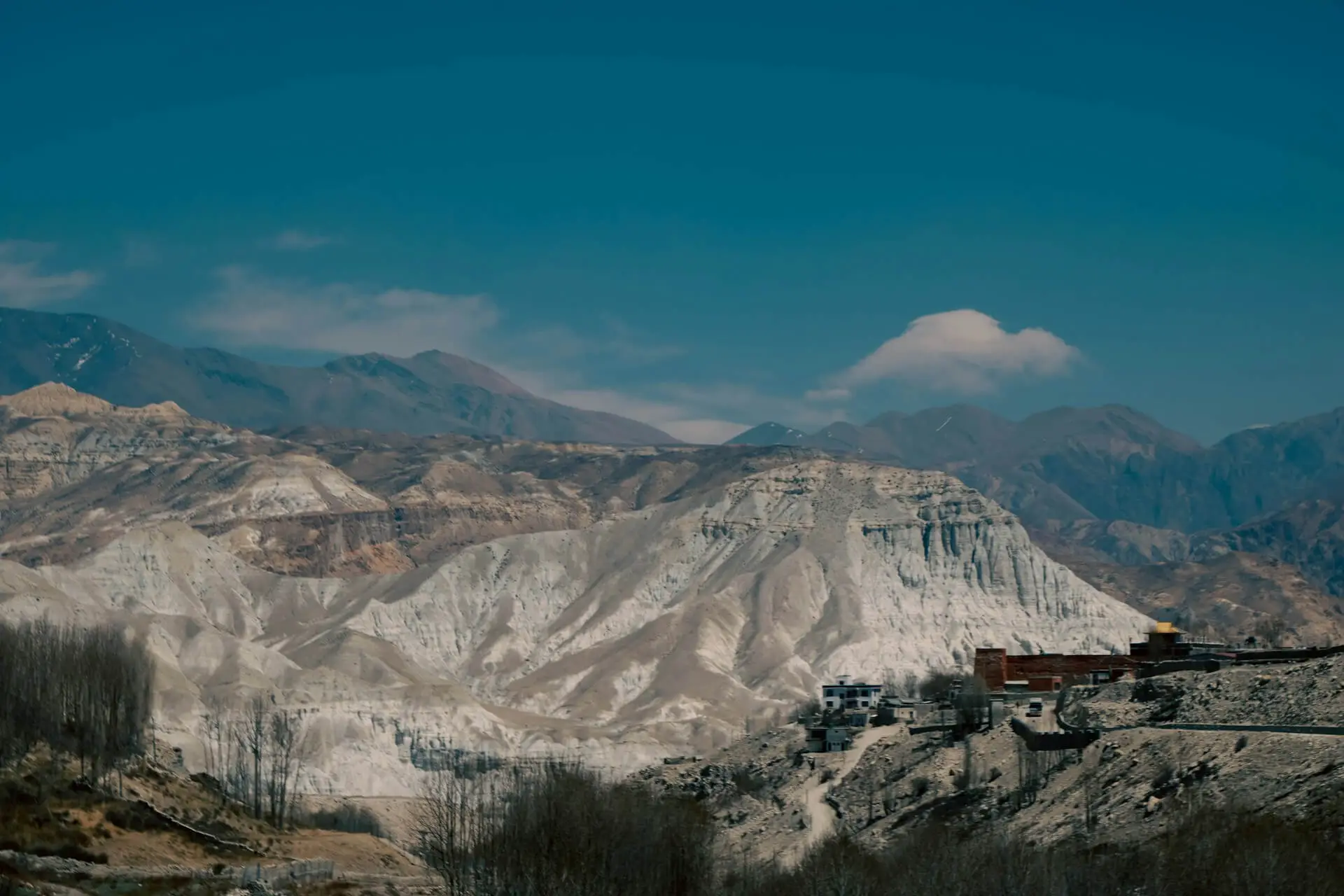
Muktinath’s Buddhist significance cannot be separated from the broader religious landscape of Mustang, the region in which it sits. Upper Mustang is a Tibetan Buddhist cultural zone that maintained political and cultural connections with Tibet long after the surrounding regions were integrated into Nepal. The monasteries of Lo Manthang, the cave meditation sites at Chhoser, and the religious art preserved in the valley’s gompas represent one of the most intact Tibetan Buddhist cultural landscapes outside Tibet itself.
Within this landscape, Muktinath is the pilgrimage anchor at the southern edge of the region, the point where the Tibetan Buddhist world meets the Hindu world of the lower Kali Gandaki valley, and where both traditions converge on the same sacred ground.
The Coexistence at the Site
The practical reality of Muktinath as a shared sacred site is visible in how the compound operates on any given day. Hindu pilgrims from Rajasthan, Tamil Nadu, and the Kathmandu Valley move through the 108 spouts in the ritual sequence. Buddhist pilgrims from Mustang, Dolpo, and Tibet circumambulate the compound clockwise, spinning prayer wheels as they walk. Both groups move through the same space without conflict or formal separation, because the site belongs to both traditions in a way that neither has claimed exclusively.
The administration of the complex reflects this duality. The Hindu temple and the Buddhist monasteries are managed by their respective religious communities. The broader site is accessible to pilgrims and visitors of all backgrounds. The eternal flame shrine, Jwala Mai, is considered sacred in both traditions for its own reasons and is visited by both Hindu and Buddhist pilgrims without distinction.
This coexistence is not new and is not the result of deliberate pluralism. It reflects the religious history of the Mustang region, where Hindu and Buddhist traditions have existed in proximity for centuries without one displacing the other. The overlap at Muktinath is the geographical and spiritual expression of that history.
Getting to Muktinath
Muktinath is accessible by road from Jomsom, the nearest airport, via a jeep journey of approximately one to two hours. The flight from Pokhara to Jomsom takes 25 minutes and operates in the morning only due to the valley wind conditions that make afternoon flying unsafe. From Jomsom, the road follows the Kali Gandaki north through Marpha and Kagbeni before climbing to Ranipauwa at the base of the Muktinath compound.
The approach on foot from Ranipauwa to the temple complex takes 20 to 30 minutes up a steady path. Ponies and jeeps are available for those who need them. The compound is open daily, and the busiest pilgrimage periods coincide with Hindu festival calendars, particularly Yartung in August and the period around Janai Purnima.
Adventure World Trails and Travels arranges Muktinath visits as part of Upper Mustang itineraries and standalone Muktinath pilgrimage programmes. Contact the team for itinerary details and departure scheduling.
FAQs
1. Is Muktinath Temple open to non-Hindu visitors?
Yes. Muktinath is open to visitors of all religious backgrounds and nationalities. The compound, including the Vishnu shrine, the 108 spouts, and the Buddhist temples, is accessible to anyone who arrives respectfully. Removing shoes before entering temple buildings and dressing modestly, with shoulders and legs covered, is expected. Photography within the inner sanctum of the main shrine may be restricted and should be confirmed with the temple staff on arrival.
2. What is the significance of the 108 water spouts at Muktinath?
The 108 spouts are the central ritual feature of the Muktinath complex for Hindu pilgrims. Bathing under each spout in sequence is believed to purify accumulated karma and bring the pilgrim closer to moksha, liberation from the cycle of rebirth. The number 108 holds deep significance in Hindu cosmological tradition, appearing across sacred texts, rosary practice, and ritual throughout the tradition. In Buddhist tradition, the same spouts are counted as one hundred, and the water is associated with purification and the accumulated spiritual power of the site.
3. What is the eternal flame at Muktinath and why is it significant?
The eternal flame burns inside the Jwala Mai shrine from a natural gas seepage beneath the ground. The flame burns continuously alongside flowing water and the earth of the valley floor, creating a convergence of fire, water, and earth that both Hindu and Buddhist traditions consider a manifestation of divine or cosmic power. The flame is considered self-sustaining, not maintained by human intervention, which is the source of its religious significance. It has burned continuously for as long as the recorded religious history of the site extends.
4. What is the best time of year to visit Muktinath Temple?
The spring season from March through May and the autumn season from September through November are the most practical windows for visiting Muktinath. Both periods offer reliable road access from Jomsom, stable flying conditions for the Pokhara to Jomsom flight, and comfortable daytime temperatures despite the altitude. The monsoon period from June through September brings rain to the lower valleys, though the Mustang region sits in a rain shadow and receives less precipitation than the main Himalayan routes. Winter from December through February brings cold conditions and occasional road closures due to snow above Jomsom.
5. Can Muktinath be visited as a day trip or does it require an overnight stay?
A day trip from Jomsom to Muktinath is possible and covers the compound visit with time to walk the ritual circuit at the 108 spouts and visit the Buddhist temples. An overnight stay at Ranipauwa or Muktinath village is recommended for trekkers who want to experience the site in the early morning before jeep traffic arrives from Jomsom, for pilgrims who want to complete the full ritual circuit with adequate time, and for anyone continuing north into Upper Mustang the following day. Adventure World Travel can arrange either a day visit or overnight itineraries depending on the broader programme.