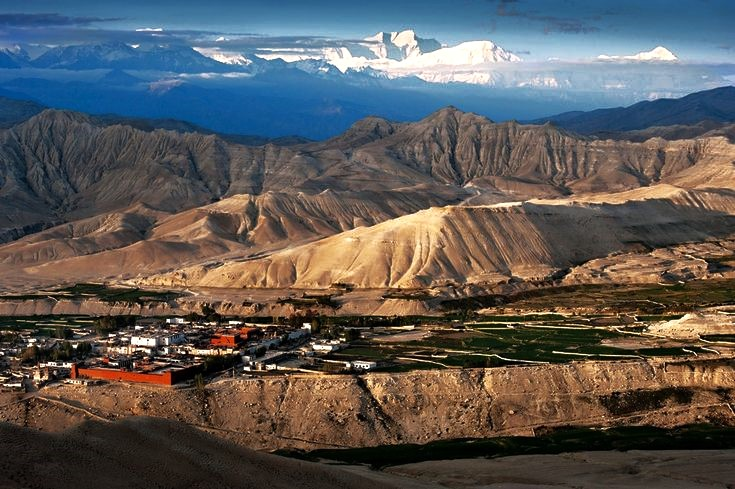
Mustang sits in the rain shadow of the Annapurna and Dhaulagiri ranges in northern Nepal, cut off from the monsoon and shaped by Tibetan plateau geography rather than the Himalayan foothills that define most Nepal trekking. The landscape is dry, wind-carved, and ochre-coloured. The culture is Tibetan Buddhist. The terrain is unlike anywhere else in the country.
The region divides into two distinct trekking experiences: Lower Mustang, which runs from Kagbeni up to the Kali Gandaki gorge corridor, and Upper Mustang, the restricted area north of Kagbeni that reaches the ancient walled city of Lo Manthang near the Tibetan border.
They share the same geography and cultural heritage but deliver fundamentally different experiences in terms of access, cost, permit requirements, crowd levels, and what you actually see on the ground.
This article breaks down both options honestly so you can make the right call for your trip.
The Basic Distinction
The boundary between Lower and Upper Mustang is the checkpoint at Kagbeni. South of Kagbeni, the trail is open to any trekker with standard permits. North of Kagbeni, a restricted area permit is required and the daily fee is significant. This single regulatory boundary creates two different trekking markets serving two different types of traveller.
Lower Mustang covers the Kali Gandaki corridor from Jomsom northward through Kagbeni, taking in villages like Marpha, Tukuche, and the dramatic gorge terrain that makes this one of the world’s deepest river valleys. Upper Mustang covers the plateau landscape north of Kagbeni through Chele, Syangboche, Ghami, Tsarang, and ultimately Lo Manthang at 3,840 metres.
Both regions share the same Tibetan Buddhist cultural foundation, the same apple orchards and whitewashed villages, and the same stark high-altitude desert aesthetic. The differences are in depth, remoteness, permit cost, and the specific character of each experience.
Lower Mustang: What It Offers
Lower Mustang follows the Kali Gandaki river valley, one of the world’s deepest gorges, through a corridor that has served as a trans-Himalayan trade route for centuries. The landscape shifts from green terraced fields around Jomsom to increasingly arid terrain as the trail moves north toward Kagbeni.
The key stops along Lower Mustang carry their own character. Marpha is a well-preserved Newari-style village famous for its apple orchards and brandy production. The whitewashed stone lanes, flat-roofed houses, and central drainage channel give it a distinctly medieval feel that has survived relatively intact.
Jomsom, the main hub for the region, has grown significantly with tourism infrastructure but retains a dramatic setting between the Nilgiri and Dhaulagiri ranges. Kagbeni itself is the most atmospheric settlement in Lower Mustang, a maze of mud-brick architecture and narrow lanes at the confluence of the Kali Gandaki and Muktinath rivers where the Upper Mustang checkpoint marks the edge of the open trekking zone.
Lower Mustang also serves as the access route for Muktinath, one of the most sacred pilgrimage sites in Nepal for both Hindus and Buddhists. The temple complex at 3,710 metres draws pilgrims from across South Asia and sits above the Mustang valley with views of the surrounding Himalayan peaks.
The standard Lower Mustang itinerary runs five to seven days from Jomsom, which is accessible by flight from Pokhara. The trail is not technically demanding and carries moderate traffic, particularly during spring and autumn when Annapurna Circuit trekkers pass through the region.
Permits for Lower Mustang require the standard TIMS card and Annapurna Conservation Area permit. No restricted area permit is needed. The relatively low permit cost makes Lower Mustang accessible to a wider budget range.
The limitation of Lower Mustang is that it represents the accessible, infrastructure-developed face of the Mustang region. Teahouses are well established, jeep roads run through parts of the trail, and the remoteness that defines Upper Mustang is largely absent. It is a genuine and rewarding trekking experience but it does not deliver the sense of having reached somewhere truly removed.
Upper Mustang: What It Offers
Upper Mustang is a different proposition. The restricted area permit costs USD 500 per person for ten days, with an additional USD 50 per day beyond that. This cost alone filters the visitor profile significantly, keeping Upper Mustang among the least crowded trekking destinations in Nepal relative to its cultural and scenic significance.
The landscape north of Kagbeni is immediately different. The terrain opens into high plateau with eroded cliff formations, wind-sculpted canyons, and a colour palette that runs from deep red to pale yellow across the rock faces. The trail passes through villages that have changed little in centuries, where Tibetan Buddhism is practiced in its traditional form and the cultural continuity with the pre-annexation Tibetan kingdom of Lo is palpable.
The major settlements of Upper Mustang each carry their own significance. Chele sits above a dramatic gorge at the entrance to the upper plateau. Ghami has one of the longest mani walls in Nepal. Tsarang contains a fortress palace and monastery that date to the Lo Kingdom’s historical period.
Lo Manthang, the walled capital of the former Kingdom of Lo, is the centrepiece of any Upper Mustang itinerary. The city walls enclose a compact medieval settlement with royal palace ruins, monasteries housing ancient thangkas and manuscripts, and a community that maintains its Tibetan cultural identity with a depth that few places outside Tibet itself can match.
The Tiji Festival at Lo Manthang, held annually in May, is one of the most significant Tibetan Buddhist festivals in the Nepal Himalaya. The three-day masked dance ceremony draws increasing numbers of travellers willing to time their Upper Mustang trek to coincide with it. Witnessing Tiji at Lo Manthang is one of the more distinctive cultural experiences available on any Nepal trek.
The standard Upper Mustang itinerary runs twelve to fourteen days from Jomsom to Lo Manthang and back, or with variations through the eastern or western return routes. The trail involves some altitude gain but remains non-technical throughout. The physical challenge is moderate, with the permit cost rather than the terrain being the primary barrier for most travellers.
The restriction on Upper Mustang has a deliberate effect. Fewer trekkers means the villages retain their character rather than orienting around trekking tourism. Interactions with local communities feel less transactional. The pace of the journey is different when the trail is not busy.
Side by Side: The Key Differences
Access and Permits
Lower Mustang requires standard permits available to any trekker. Upper Mustang requires a restricted area permit at USD 500 for ten days, which must be obtained through a registered trekking agency along with a mandatory licensed guide.
Costs
Lower Mustang is budget-accessible. Upper Mustang carries significant fixed costs from the permit alone, with guided trek packages typically running substantially higher than equivalent-length open-area treks.
Crowd Levels
Lower Mustang sees moderate to high traffic during peak season, particularly around Muktinath and the Jomsom-Kagbeni corridor. Upper Mustang carries very low visitor numbers by Nepal trekking standards, with the permit cost providing effective natural filtering.
Cultural Depth
Both regions share Tibetan Buddhist cultural heritage but Upper Mustang offers significantly greater depth. Lo Manthang, the monastery collections at Tsarang, the living tradition of the Lo Kingdom, and the relative absence of modern tourism infrastructure give Upper Mustang a cultural intensity that Lower Mustang does not match.
Landscape
Lower Mustang offers dramatic gorge scenery and the Kali Gandaki corridor. Upper Mustang delivers the full high Tibetan plateau experience with cliff formations, canyon erosion, and an expansive arid landscape that has no equivalent elsewhere in Nepal.
Trek Length Lower Mustang works as a five to seven day addition to an Annapurna or Pokhara itinerary. Upper Mustang requires a minimum of twelve days from Jomsom and is better treated as a standalone itinerary rather than a side trip
Which One to Choose
Lower Mustang
If your budget does not extend to the Upper Mustang permit, if you have five to seven days rather than two weeks, and you want to combine Mustang with the Annapurna Circuit or a Pokhara-based itinerary, or if Muktinath is a specific objective. It delivers genuine Himalayan trekking with cultural interest and dramatic landscape without the restricted area permit cost.
Upper Mustang
If you want the deepest cultural and landscape experience the Mustang region offers, if budget is not the primary constraint, if you have two weeks available, and if remoteness and low crowd levels matter to your trekking experience.
The permit cost is significant but it buys an experience that is genuinely uncommon on Nepal’s trekking circuit. Lo Manthang, Tsarang, and the plateau landscape north of Kagbeni are worth the investment for travellers who understand what they are going to see.
For travellers who can only do one, Upper Mustang is the more distinctive experience. Lower Mustang is the more accessible one. The right answer depends on what you are optimising for.
Adventure World Travel can build either itinerary as a standalone trek or as part of a broader Nepal programme combining Mustang with Annapurna, Pokhara, or Kathmandu cultural time.
FAQs
1. Do I need a special permit for Upper Mustang and how do I get it?
Yes. Upper Mustang requires a restricted area permit costing USD 500 per person for ten days, with USD 50 per additional day. The permit must be obtained through a registered trekking agency in Nepal and cannot be arranged independently.
A licensed guide is mandatory for the restricted area. Standard TIMS card and Annapurna Conservation Area permit are required in addition to the restricted area permit. Your trekking operator handles the full permit stack as part of the booking process.
2. What is the best time of year to trek in Mustang?
Mustang sits in the rain shadow of the Himalayas and remains trekable during the monsoon months of June to August when most Nepal trekking destinations are affected by heavy rainfall.
Spring (March to May) and autumn (September to November) are the primary seasons, with spring offering rhododendron bloom at lower elevations and the Tiji Festival in May for Upper Mustang timing. The region is also accessible in winter, though temperatures at altitude are significantly colder and some high passes may be affected by snow.
3. How difficult are the Lower and Upper Mustang treks physically?
Neither trek is technically demanding. Lower Mustang involves straightforward trail walking at moderate altitude with good teahouse infrastructure throughout. Upper Mustang involves longer daily walking stages at higher altitude with the trail reaching above 4,000 metres on some sections.
Acclimatisation days are built into the itinerary. A reasonable base fitness level and comfort with consecutive days of walking at altitude are the primary requirements for both. No technical mountaineering skills are needed for either route.
4. Can Lower and Upper Mustang be combined in a single itinerary?
Yes. Most Upper Mustang itineraries travel through Lower Mustang en route, passing through Jomsom, Kagbeni, and the surrounding villages before crossing the restricted area checkpoint.
Combining both regions into a single itinerary of sixteen to eighteen days gives the full Mustang experience from the Kali Gandaki gorge through to Lo Manthang. This is the most comprehensive way to see the region and the additional days in Lower Mustang add context to the Upper Mustang experience rather than duplicating it.
5. Is a guide mandatory for Mustang trekking?
A licensed guide is mandatory for Upper Mustang as a condition of the restricted area permit. Solo independent trekking is not permitted north of Kagbeni. For Lower Mustang, a guide is not legally required but is practically useful for navigation, local knowledge, and logistics management on a multi-day itinerary. Adventure World Travel provides experienced guides for both regions who bring cultural and geographical knowledge that adds substantially to the experience beyond basic route navigation.