
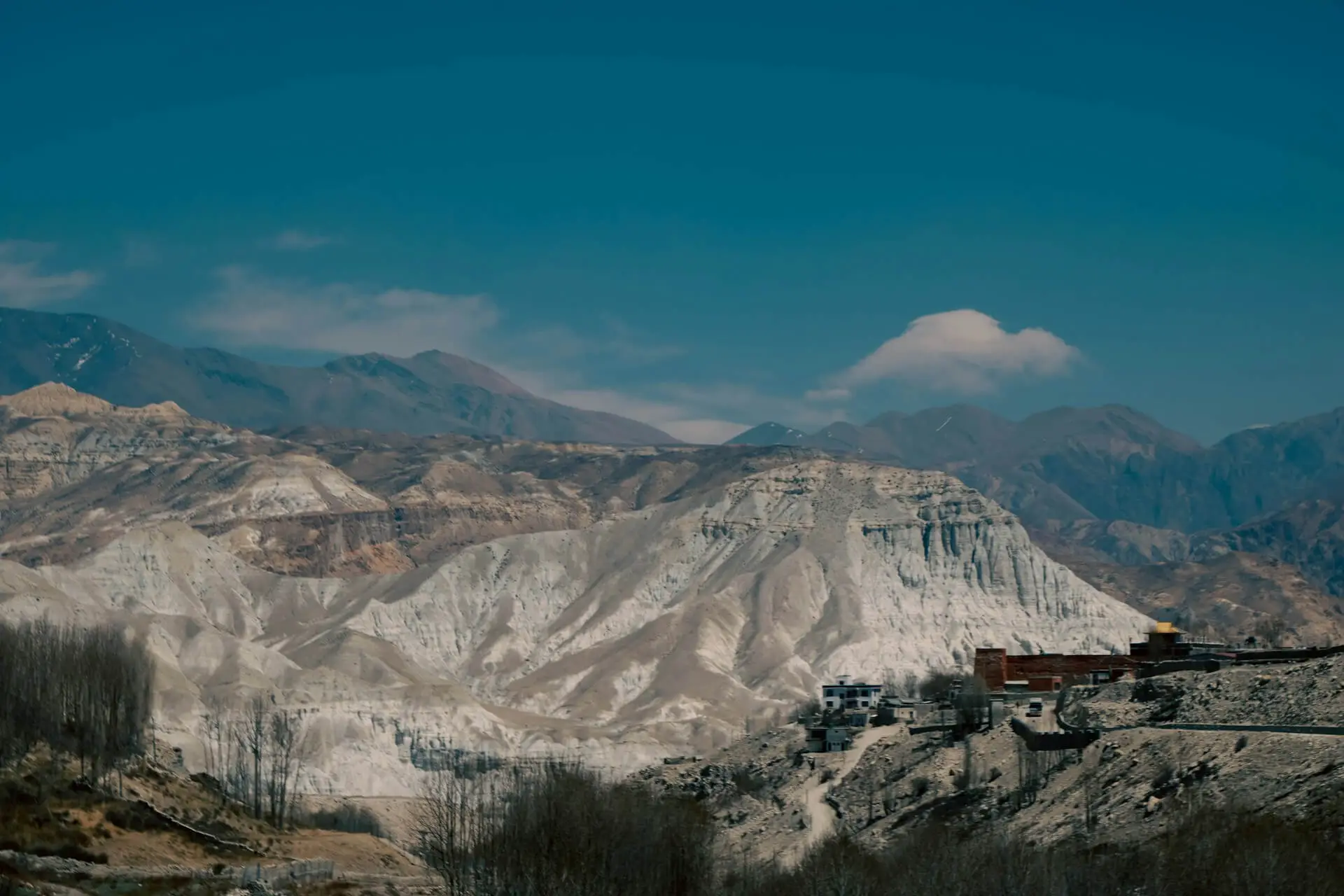
Lower Mustang does not ask much of you on paper. No restricted area permit, no mandatory guide, no USD 500 outlay before the trek begins. What it does ask is that you show up ready for a landscape and culture that feels genuinely unlike the rest of Nepal.
Tibetan Buddhist villages, the world’s deepest river gorge, one of South Asia’s most sacred pilgrimage sites, and terrain that shifts from subtropical forest to high-altitude desert within a single day’s drive. The experience punches well above its logistical weight.
Adventure World Travel’s Lower Mustang tour runs ten days from Kathmandu, covering the full journey from the capital through Pokhara and into the Mustang valley before returning. Here is exactly what that looks like.
The Full Itinerary
Day 1: Arrival in Kathmandu
The tour begins at Tribhuvan International Airport where you are met by an Adventure World Travel representative and welcomed with a Khada, the traditional white ceremonial scarf. Transfer to your hotel, check in, and receive your travel documents along with a briefing on the days ahead. The first evening is yours to settle in and rest after the journey.
Day 2: Kathmandu Sightseeing
A full day in Kathmandu covering the city’s four major heritage sites. The morning starts at Swayambhunath Stupa, the 2,000-year-old Buddhist shrine perched above the valley, where prayer wheels, carved stupas, and resident monkeys share the hilltop.
From there to Kathmandu Durbar Square, the former seat of the Nepalese monarchy, where intricately carved wooden architecture and pagoda-style temples document centuries of Newar craftsmanship.
The afternoon moves to Pashupatinath Temple, one of the most sacred Shiva temples in the world, where pilgrims from across South Asia come to worship. Note that entry inside the temple is restricted to Hindus.
The day closes at Boudhanath Stupa, the largest stupa in the valley, rising 36 metres and ringed by 108 images of Buddha and hundreds of prayer wheels. Time here to interact with monks, spin the prayer wheels, and observe the evening rituals that draw the Buddhist community together at dusk.
Day 3: Kathmandu Sightseeing Continued
The morning covers Patan Durbar Square, a UNESCO World Heritage Site housing the stone-built Krishna Mandir, the 12th-century Golden Temple monastery, and the Patan Museum with its collection of traditional art and artefacts. A Healing Bowl Therapy session is included, using Tibetan singing bowls for relaxation.
The afternoon takes place in Changu Narayan Temple, another UNESCO site east of Kathmandu, notable for its 5th century Garuda statue and its status as one of Nepal’s most significant Vishnu temples.
The day ends at Bhaktapur, the medieval city whose durbar square contains palaces, royal baths, pagodas, and Newari architecture that earns it the reputation as the most beautiful durbar in Nepal.
Day 4: Drive to Pokhara via Manakamana Temple
The drive from Kathmandu to Pokhara covers approximately 210 kilometres and takes seven to eight hours along the Prithvi Highway. En route, the itinerary stops at Manakamana Temple, the wish-fulfilling goddess temple that sits 1,300 metres above the Trishuli and Marshyangdi rivers in Gorkha district.
Pilgrims from across Nepal and beyond visit this temple, reached by cable car from the valley floor. The hilltop location delivers views of Annapurna, Himalchuli, and Manaslu.
Arrival in Pokhara in the evening. Check in and rest.
Day 5: Pokhara Sightseeing
The day starts early with the drive up to Sarangkot for sunrise, where the view takes in the full Annapurna range on one side and Phewa Lake on the other. From there to Bindhyabasini Temple, the oldest temple in Pokhara, sitting on a small hill above the old bazaar with views across the Himalayan ranges.
After breakfast back at the hotel, the morning continues with Devi’s Fall, the waterfall that disappears underground from Phewa Lake, and the adjacent Gupteshwor Mahadev cave dedicated to Lord Shiva.
The afternoon visit to the World Peace Pagoda, a 115-foot stupa standing above the lake, is followed by a boat ride on Phewa Lake to Tal Barahi Temple, the island temple accessible only by water. The evening is free at Lakeside Pokhara.
Day 6: Drive to Thasang via Galeshwor Temple, Tatopani, and Ghasa
The entry into Mustang territory begins today. After breakfast, the drive heads toward Thasang at 2,600 metres. En route, the itinerary stops at Galeshwor Temple for a moment of reflection before continuing to Tatopani at 1,190 metres for lunch, a village known for its natural hot springs at the junction of the Kali Gandaki and Myagdi rivers.
From Tatopani, the group undertakes an optional hike to Ghasa Village at 2,013 metres, a six kilometre walk of approximately two and a half to three hours that follows the Kali Gandaki river through forest and over suspension bridges.
The trail continues toward Kalapani and Lete at 2,480 metres, where the views of Dhaulagiri at 8,167 metres and Annapurna I at 8,091 metres are unobstructed. Those preferring not to hike drive directly from Tatopani to Thasang. Overnight at Thasang Village Lodge.
Day 7: Drive to Muktinath via Tukuche and Marpha
This is the day the landscape fully transforms into Lower Mustang. The drive toward Muktinath at 3,800 metres follows the Kali Gandaki Valley with the Nilgiri peaks dominating the skyline. En route, a walk through Tukuche Village at 2,590 metres, a three kilometre stroll through a settlement known for its Thakali culture and historic trade architecture from the period when the Kali Gandaki served as a major trans-Himalayan trade corridor.
From Tukuche the route passes through the apple orchards and narrow whitewashed lanes of Marpha at 2,670 metres, Nepal’s apple capital. A short two kilometre walk through the village covers its traditional stone houses, prayer flags, and central drainage lanes before continuing through Jomsom at 2,720 metres, the regional hub, toward Muktinath.
At Muktinath, the 108 water spouts and eternal flame of Jwala Mai Temple deliver the full spiritual significance of this site. A short hike or pony ride reaches the temple complex. Pilgrims bathe in the 108 ice-cold spouts as an act of purification. The afternoon is free at Muktinath before settling in for the night.
Day 8: Kagbeni, Thini Village, Dhumba Lake, and Drive to Tatopani
The morning visits Kagbeni, the atmospheric confluence village at 2,800 metres where the Kali Gandaki and Jhong rivers meet and the Upper Mustang checkpoint marks the edge of the restricted zone. The ancient mud-brick alleys, monastery, and stark plateau views to the north make Kagbeni one of the most memorable stops on the entire tour.
From Kagbeni a short walk leads to Thini Village at 2,840 metres, one of the oldest settlements in the Mustang region, and the nearby Dhumba Lake, where the Nilgiri peaks reflect on calm water. The afternoon drive descends back to Tatopani at 1,190 metres, a four to five hour journey that watches the arid Mustang landscape give way to green lower Himalayan forest. The evening at Tatopani is spent in the natural hot spring pools, a welcome recovery after the days of high-altitude travel.
Day 9: Drive to Pokhara, Fly to Kathmandu, Rickshaw Ride at Thamel
An early breakfast before the drive back to Pokhara, retracing the Kali Gandaki road through villages, waterfalls, and terraced farmland. A brief stop in Pokhara before the domestic flight to Kathmandu, approximately 25 minutes with aerial views of the Annapurna and Manaslu ranges.
On arrival in Kathmandu, a rickshaw ride through Thamel provides a fitting close to the Nepal portion of the journey. The narrow lanes, handicraft shops, and street-level energy of Thamel are a complete sensory contrast to the high plateau solitude of the days just passed. Overnight in Kathmandu.
Day 10: Final Departure
Breakfast and transfer to Tribhuvan International Airport for the departure flight.
What Is Included
The Adventure World Travel Lower Mustang tour includes an experienced English-speaking cultural guide throughout, porters for luggage, all hotels on a MAP basis covering breakfast and dinner, picnic or lunch from days one to nine, private transport, Nepali staff insurance, and international airport transfers.
Not included: personal travel insurance, Nepal visa, personal beverages and expenses, and cultural site entrance fees.
Practical Tips
Here are some practical tips you can follow to maximize your trip potential when setting off to Upper Mustang.
- Book morning flights to and from Jomsom. The afternoon winds in the Kali Gandaki valley are strong and predictable. All flights on this route operate in the morning. Build a weather buffer day into the itinerary if your international connections are tight, as weather delays at Jomsom are common.
- Carry cash from Jomsom onward. ATM access exists in Jomsom but not beyond. Have sufficient Nepali rupees for the full duration before leaving Jomsom.
- Layer your clothing. The temperature range across the ten days is significant. Tatopani at 1,190 metres is warm. Muktinath at 3,800 metres is cold, particularly at night and in early morning. Packing for both without carrying excess weight requires thought.
- Acclimatise gradually. Muktinath is reached relatively quickly on this itinerary. Staying well hydrated, ascending the last section slowly, and being aware of headache or nausea as early indicators of altitude sickness is standard practice at this elevation.
FAQs
1. What permits are required for the Adventure World Travel Lower Mustang tour?
Lower Mustang requires a TIMS card and the Annapurna Conservation Area Permit. No restricted area permit is needed. The restricted area begins at the Kagbeni checkpoint and applies only to Upper Mustang north of that point. Adventure World Travel handles permit arrangements as part of the tour booking process.
2. How physically demanding is this tour?
The Lower Mustang tour is designed to be accessible to a wide range of fitness levels. Most of the distance is covered by jeep or private vehicle. The walking sections at Ghasa, Tukuche, Marpha, Thini Village, and around Muktinath are optional or short in duration. A reasonable base level of fitness for walking at altitude is sufficient. The highest point on the itinerary is Muktinath at 3,800 metres, which most travellers reach without significant altitude difficulty given the gradual ascent over the preceding days.
3. What is the best time of year for the Lower Mustang tour?
Spring from March to May and autumn from September to November are the primary seasons. Lower Mustang sits in the Himalayan rain shadow and receives significantly less monsoon rainfall than most of Nepal, making it more viable in June to August than most other Nepal trekking destinations. Spring offers rhododendron bloom at lower elevations and clear mountain views. Autumn delivers the sharpest visibility and the most stable weather for flights. Winter is cold at altitude but accessible for those prepared for low temperatures.
4. Is the tour suitable for families with children?
The itinerary suits families with older children who are comfortable with full days of travel and some walking at altitude. The jeep-based approach reduces the physical demands significantly compared to a trekking itinerary. Muktinath at 3,800 metres is the primary altitude consideration for younger travellers. Families should consult with Adventure World Travel about adjusting the pace of specific days to suit their group’s needs.
5. What is the accommodation like on the Lower Mustang tour?
Kathmandu and Pokhara nights are in standard hotels with full facilities. Accommodation in the Mustang region including Thasang, Muktinath, and Tatopani is in teahouse or lodge-style accommodation appropriate to each location. The Thasang Village Lodge offers a comfortable base for the Mustang section of the itinerary. All accommodation is included in the tour price on a MAP basis covering breakfast and dinner throughout.