There are places in Nepal that feel like they exist outside normal time. Lo Manthang is one of them. Lo Manthang sits at 3,840m in Upper Mustang, northern Nepal. It served as the capital of the independent Kingdom of Lo for over 600 years. Inside its mud-brick walls are four medieval monasteries, a royal palace, and a living Tibetan Buddhist community. A jeep road now connects it to Jomsom, but the walled city of upper Mustang character remains largely intact. The important heritages of the place, its monasteries, its festivals, its Tibetan Buddhist identity, and the landscape that surrounds it, remains unlike anywhere else accessible from Nepal.
For travellers who make it to Lo Manthang, the experience is consistently described as one of the most significant of any Nepal journey.
The Kingdom of Lo
Lo Manthang’s significance cannot be separated from its history as a royal capital. The Kingdom of Lo, also known as Mustang, was an independent Tibetan-speaking kingdom that maintained its distinct political identity even as Nepal absorbed the surrounding territory in the 18th century. The kings of Lo, the Raja of Mustang, continued to hold ceremonial authority in the region until 2008 when Nepal abolished its own monarchy and the formal recognition of the Lo kingdom ended alongside it.
The current royal palace, a multi-storey whitewashed structure that rises above the roofline of the walled city, is still occupied by the royal family. The palace is visible from the main square and from outside the city walls and is one of the architectural anchors of the Lo Manthang skyline. The continuity of royal presence in a city that has been a capital for over 600 years gives Lo Manthang a living historical depth that archaeological sites alone cannot replicate.
The city was founded in the 14th century under King Ame Pal and the original walled enclosure has expanded modestly over the centuries while retaining its essential medieval structure. Inside the walls, narrow lanes connect residential compounds, monasteries, and the royal palace in a layout that was designed for the community it housed rather than for visitors. Walking through Lo Manthang is a spatial experience that feels genuinely different from any other town in Nepal.
Inside the Walls of Lo Manthang
The walls of Lo Manthang are the defining feature of the city from a distance. Made of rammed earth and mud brick, they rise to several metres in height and enclose the main residential and religious core of the city. The main gate faces south and is the primary entry point for visitors arriving from Ghami and the main Upper Mustang trail.
Inside, the lanes are narrow, often just wide enough for two people to pass. The houses are flat-roofed, whitewashed, and stacked close together in a density that reflects the original logic of a fortified settlement where space inside the walls was finite and precious. Rooftop terraces covered in firewood stacks and drying vegetation are visible above the lane level, and prayer flags hang across the gaps between buildings throughout.
The religious architecture inside the walls is the most significant draw for visitors. Lo Manthang has four main monasteries within or immediately adjacent to the walled city, each carrying art collections and ritual objects of considerable age and importance.
The 4 Must Visit Monasteries Inside Lo Manthang
1. Thugchen Gompa
Thugchen Gompa is the largest monastery in Lo Manthang, a red-walled structure dating to the 15th century. The main assembly hall houses a large Maitreya Buddha image and walls covered in murals that have been partially restored through international conservation efforts. The scale of the interior and the quality of the surviving mural work make it one of the most significant examples of Tibetan Buddhist art accessible anywhere in Nepal.
2. Jampa Lhakhang
Jampa Lhakhang is a 15th-century monastery built around a towering Maitreya statue which is the Buddha of the future. It is decorated with murals that art historians consider among the finest surviving examples of Himalayan Buddhist painting. The scale and detail of the paintings cover entire walls from floor to ceiling, depicting deities, narratives, and iconography that have been preserved here for over five hundred years.
3. Chodey Gompa
Chodey Gompa and Namgyal Gompa complete the four main religious structures in the city. Together they represent a concentrated collection of Tibetan Buddhist heritage that is extraordinary even by the standards of a region that contains some of the oldest surviving religious art in the Himalayan world.
4. Namgyal Gompa
Namgyal Gompa sits on a ridge to the west of Lo Manthang, about a two-hour walk from the walled city. Known as the Monastery of Victory, it is the most active gompa in Lo and one of the most visually striking. It is perched high enough to look back over the entire valley with the Himalayas behind it. It has drawn monks and pilgrims from Nepal and Tibet for centuries, and still hosts regular rituals and ceremonies today. The walk up is worth it as much for the views as for the monastery itself.
The Tiji Festival of Lo Manthang
The Tiji Festival Lo Manthang is the most significant cultural event and one of the most visually compelling festivals in the Nepal Himalaya. Held annually over three days in late April or May, the timing is determined by the Tibetan lunar calendar and shifts slightly from year to year.
Tiji, short for Tempa Chirim (meaning ‘prayer for world peace’), enacts the story of a deity named Dorje Jono who battles demons threatening to destroy the Kingdom of Lo. The three days of ceremony involve monks in elaborate costumes and masks performing ritual dances in the main courtyard of Lo Manthang’s assembly ground, with the sequence of dances telling the narrative across the festival’s arc. The final day culminates in the defeat of the demonic forces and the restoration of peace to the kingdom.
Tiji Festival dates 2025: May 24–26 | 2026: April 13–15
The Tiji Festival in Upper Mustang is a three-day ritual known as “The Chasing of the Demons.” Based on the Tibetan lunar calendar, the upcoming dates are:
- 2025: May 24, 25, and 26
- 2026: May 13, 14, and 15
Tiji Festival Custom and Heritage
The masks and costumes used in the festival are centuries old and are stored in the monasteries between festivals. The performance draws the entire community of Lo Manthang and the surrounding villages, with families travelling from outlying settlements to participate. The communal energy of the festival, combined with the backdrop of the walled city and the surrounding plateau landscape, makes it one of the most immersive cultural experiences available on any Nepal itinerary.
Travellers who time their Upper Mustang trek to coincide with Tiji witness a festival that has been performed continuously in this location for generations. The number of international visitors who attend has grown, but the festival remains the community’s own event rather than a performance staged for tourists.
The Landscape Around Lo Manthang
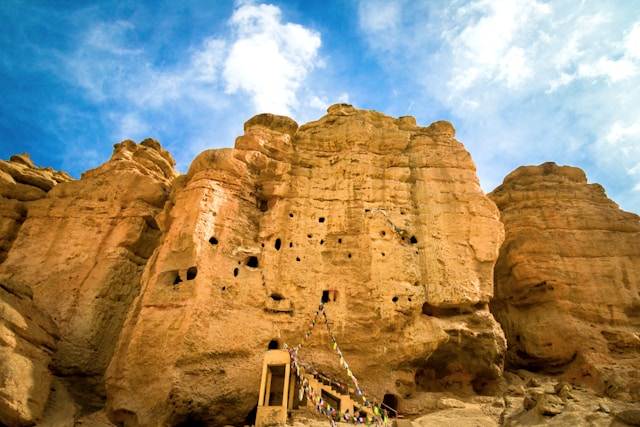
The city sits on a relatively flat plateau surrounded by the eroded canyon landscape that defines Upper Mustang. The terrain around Lo Manthang is visually extraordinary in a way that is entirely different from the forested mountain scenery that most Nepal trekking destinations offer. The rock has been carved by wind and water into formations that range from layered cliff faces in ochre and red to isolated spires and canyon corridors that appear almost architectural in their precision.
The plateau’s openness means the sky dominates. At 3,840 metres with no significant tree cover, the light in Lo Manthang shifts dramatically across the day, from the sharp cold clarity of early morning through the warm direct light of midday to the rich amber of late afternoon across the canyon walls. For photographers, the landscape around Lo Manthang at golden hour is one of the most compelling subjects in the entire Himalayan region.
The area around Lo Manthang also contains meditation caves cut into cliff faces, some of which were occupied by monks and hermits for centuries. The caves at Chhoser, a short ride from Lo Manthang, are among the most accessible and include multi-storey structures carved directly into the cliff face. Archaeological finds in the caves of the wider Mustang region have included artefacts estimated to be thousands of years old, suggesting human habitation of this plateau long before the founding of the Kingdom of Lo. This makes Lo Manthang a key destination for photography-focused itineraries.
Getting to Lo Manthang
Lo Manthang is in the Upper Mustang restricted area and cannot be reached without a restricted area permit. The permit costs USD 500 per person for ten days with USD 50 per additional day, and must be obtained through a registered trekking agency. A licensed guide is mandatory and independent trekking in the restricted area is not permitted.
The standard approach is to fly from Pokhara to Jomsom, which takes approximately twenty minutes, and then travel north through Kagbeni, Chele, Syangboche, Ghami, and Tsarang before arriving at Lo Manthang.
The full journey from Jomsom to Lo Manthang takes four to five trekking days at a reasonable pace with acclimatisation considered. A jeep road now connects the full route and some travellers drive sections of it, though trekking the trail provides the progressive landscape experience that makes the arrival at Lo Manthang meaningful.
The standard Upper Mustang itinerary runs twelve to fourteen days from Jomsom, allowing time to explore Lo Manthang and the surrounding area before returning. Some itineraries use an alternative return route through the eastern or western variations of the trail to avoid retracing the same path.
Adventure World Travel designs Upper Mustang itineraries that include Lo Manthang as the central destination, with flexible scheduling around the Tiji Festival for travellers who want to time their visit to coincide with it.
FAQs
1. Do I need a special permit to visit Lo Manthang?
Yes. Lo Manthang is in the Upper Mustang restricted area which requires a permit costing USD 500 per person for ten days, with USD 50 per additional day. The permit must be obtained through a registered trekking agency and a licensed guide is mandatory. Standard TIMS and Annapurna Conservation Area permits are required in addition. Your trekking operator handles the full permit stack as part of the booking process.
2. When is the Tiji Festival in Lo Manthang?
Tiji is held over three days in late April or early May each year, with the exact dates determined by the Tibetan lunar calendar and shifting slightly from year to year. For travellers who want to time their visit to coincide with the festival, Adventure World Travel can advise on the specific dates for the upcoming season and adjust the itinerary accordingly.
3. How long does it take to trek from Jomsom to Lo Manthang?
The standard trekking itinerary from Jomsom to Lo Manthang takes four to five days, passing through Kagbeni, Chele, Syangboche, Ghami, and Tsarang. A jeep road connects the full route and some sections can be driven, though most travellers trek the majority of the distance to experience the progressive landscape change. The full Upper Mustang itinerary including Lo Manthang exploration and return runs twelve to fourteen days from Jomsom.
4. What is the best time of year to visit Lo Manthang?
Spring from March to May and autumn from September to November are the primary seasons. Spring offers the rhododendron bloom on the lower Mustang approach, warmer temperatures, and the Tiji Festival in late April or May. Autumn delivers the clearest mountain views of the year after the monsoon has washed the atmosphere clean. Lo Manthang sits in the Himalayan rain shadow and receives very little monsoon precipitation, making it more accessible year-round than most Nepal trekking destinations.
5. Is Lo Manthang suitable for first-time high-altitude trekkers?
The trek to Lo Manthang is non-technical but reaches 3,840 metres at the city itself with some sections of the surrounding area above 4,000 metres. Proper acclimatisation is built into the itinerary with rest days at appropriate elevations. A reasonable base fitness level and comfort with consecutive days of walking at altitude are the primary requirements. First-time high-altitude trekkers should discuss their fitness level and experience with Adventure World Travel before booking to ensure the itinerary pacing suits their specific situation.